🌿 The Lost Art of Wattle: A Guide to Stronger Natural Fences & Baskets
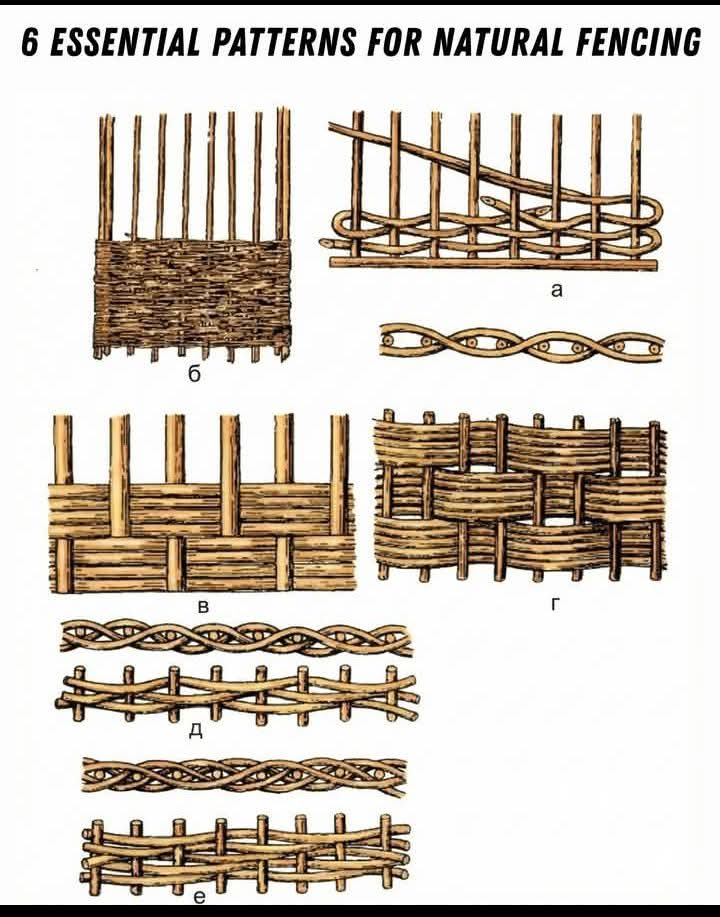
Ever wonder how ancient fences stood for years without nails or wire? The secret is in the weave. This diagram—a gem from an vintage Eastern European manual—illustrates the fundamental techniques used for centuries to build everything from garden fences to house walls.
(💡 Fun Fact: The letters in the image are Cyrillic! They correspond to A, B, V, G, D, E in our alphabet.)
Here is the breakdown of exactly what you are looking at so you can try it in your own garden:
🔹 1. Randing (Labeled 'б' / B - Top Left)
This is the most common and basic weave.
How it works: A single rod (weaver) is passed in front of one stake and behind the next.
Best for: Filling in the main body of a fence securely. It creates a solid wall but requires staggering your starting points to keep the fence straight.
🔹 2. Fitching / Open Work (Labeled 'a' / A - Top Right)
Notice the gaps? That is intentional.
How it works: Two rods are twisted around each upright stake (twining), locking them in place while leaving open space between the rows.
Best for: Garden fences where you want air to flow through or plants to climb, while still keeping the structure rigid.
🔹 3. Splint / Plaiting (Labeled 'в' / V - Middle Left)
This uses a different material entirely—flat strips rather than round rods.
How it works: Flat strips of split wood (often Hazel, Oak, or Ash) are woven in a simple over-under pattern.
Best for: Creating a very flat, smooth surface. Historically used for wall panels or tray bottoms.
🔹 4. Slewing (Labeled 'г' / G - Middle Right)
A variation of randing for speed and strength.
How it works: Instead of one rod, you take a bundle of 2, 3, or 4 rods and weave them together as a single unit. You do not twist them; they lie flat side-by-side.
Best for: Covering large areas quickly. It creates a bold, texture-rich look.
🔹 5. Pairing & Waling (Labeled 'д' / D and 'е' / E - Bottom)
These diagrams show the "top-down" view of the most structural weaves.
Pairing ('д'): Two rods twist around each other between every stake. This locks the stakes in exact spacing so they can't wobble.
Waling ('е'): Often done with three rods (a 3-rod wale). This creates a rope-like band that is incredibly strong.
Pro Tip: Always start and finish a woven fence with a few rows of this to stop the whole thing from unraveling.
🌱 Best Materials to Use:
Willow (Osier): The gold standard. Flexible and durable.
Hazel: Excellent for the upright stakes and split-wood weaves.
Dogwood & Fruit Tree Pruning's : Great for adding color and detail.
Why learn this?
It requires zero electricity, costs nothing if you have the trees, and creates a fence that can flex in the wind (unlike stiff panels that break).
Have you ever tried weaving willow or hazel? Drop a picture of your projects below! 👇
No comments:
Post a Comment