
31.5.25


30.5.25
The Easiest Way to Harvest and Preserve Fresh Grape Leaves
The Easiest Way to Harvest and Preserve Fresh Grape Leaves
".... Select whole leaves, free of damage, from vines that have not been sprayed with pesticides. Leaves should display a light green color and have a supple texture. Seek out the best picks just below the new growth at the top of the plant and close to the fruit. To sustainably harvest them, leave the first 3 leaves following any new growth at the end of the vine, and then pick the next two to three leaves. After that, move on to the next stem.
...
Blanching
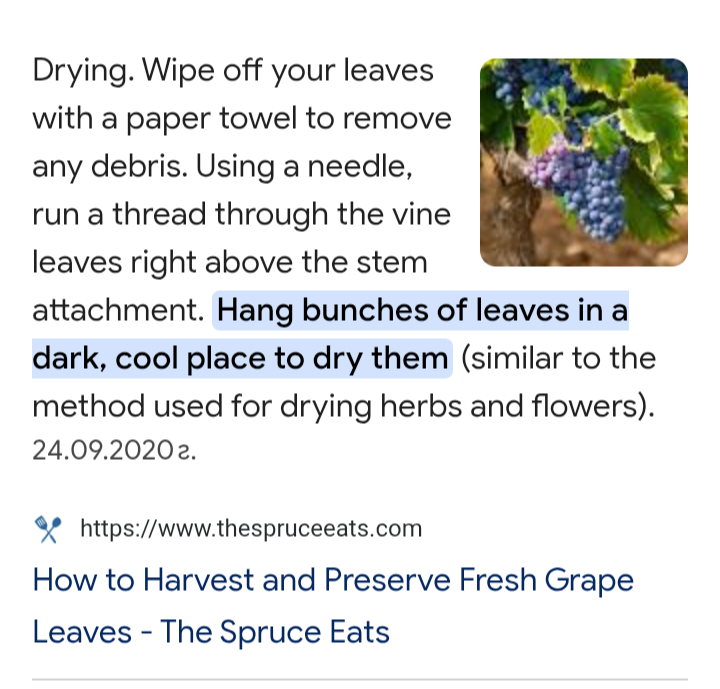
Drying
".... Select whole leaves, free of damage, from vines that have not been sprayed with pesticides. Leaves should display a light green color and have a supple texture. Seek out the best picks just below the new growth at the top of the plant and close to the fruit. To sustainably harvest them, leave the first 3 leaves following any new growth at the end of the vine, and then pick the next two to three leaves. After that, move on to the next stem.
Grape leaves should be at least the size of the palm of your hand, large enough to wrap around a filling.
Blanching
Blanching
To prepare leaves for blanching, use a sharp knife or scissors to cut the stem off of each leaf. Then, rinse well under cold running water.
To blanch, boil water in a teakettle. Place your leaves in a pot or heavy bowl, cover them with boiling water, and then let them sit for about 2 minutes or until soft, but not mushy. Alternately, you can bring a large pot of water to a boil, turn off the heat, add the leaves, and let them sit for the same amount of time. Using tongs, transfer blanched leaves from the hot water into an ice bath. Once cool, drain and squeeze out all of the water, pat the grape leaves dry with paper towels, and use them in your favorite recipe
Drying
Wipe off your leaves with a paper towel to remove any debris. Using a needle, run a thread through the vine leaves right above the stem attachment. Hang bunches of leaves in a dark, cool place to dry them (similar to the method used for drying herbs and flowers). Once dried, pack bunches (still tied together and enough for one recipe) in plastic bags and store them for future use. When you're ready to cook, hold the bunch by the string and dip each leaf in boiling water for about 2 to 3 minutes. The color will turn a light green. Use as directed in your recipe
26.5.25
Y FB How to construct a monkey bridge (or rope bridge)
This illustration demonstrates how to construct a monkey bridge (or rope bridge), a popular pioneering project often used in scouting and outdoor survival scenarios. Here's a breakdown of the components and steps based on the visual elements:

17.5.25


4.5.25


29.4.25
НСС олио: шарлан (слънчогледово нерафинирано) и др.
1 ,2, 3
1 Мой коментар:
Алтернативна добра практика на Людмил Етов е вместо олио да се консумира консумират смлени семена или ядки ( фъстъчене например).
Тоест спира се след смилането и с кафемелачка / блендер, показано във видеото.
Въпрос е дали да се оставят сурови вместо да се запичат преди смилане. Доколкото ми е известно само фъстъците са по-полезни след термична обработка сред ядките.
2 V Как ХИМИКАТАМИ [бензином] извлекают МАСЛО (Экстрадирование масла растворителем). Рафинирование.


23.4.25
Blanching (cooking)

"Blanching is a process in which a food, usually a vegetable or fruit, is partially cooked by first scalding in boiling water, then removing after a brief timed interval, and finally plunging into iced water or placing under cold running water (known as shocking or refreshing) to halt the cooking process. Blanching foods helps reduce quality loss over time.[1] Blanching is often used as a treatment prior to freezing, dehydrating, or canning vegetables or fruits to deactivate enzymes, modify texture, remove the peel and wilt tissue.[2] The inactivation of enzymes preserves colour, flavour, and nutritional value.[2] The process has three stages: preheating, blanching, and cooling.[1] The most common blanching methods for vegetables/fruits are hot water and steam, while cooling is either done using cold water or cool air.[3][4] Other benefits of blanching include removing pesticide residues and decreasing microbial load.[4] Drawbacks to the blanching process can include leaching of water-soluble and heat-sensitive nutrients and the production of effluent.[2]


19.4.25
0 ЕНЕРГИЯ + Зелена защита от вятър за дома
1, 2, 3, 4, 5 (PDF)
1
Fb-Ig Landscaping for Energy Efficiency - Zero Energy project

2
.Landscaping for Energy Efficiency - Zero Energy

3
Energy efficient landscaping: How it works ('23)
Energy efficient landscaping is the act of designing and implementing (or retrofitting) the surroundings of a building to reduce its energy consumption and help it cope with Climate Change. I
- Energy efficiency with plants |
- hading your home Insulating your home
- Embrace native plants Smart irrigation systems
- Sustainable hard-scaping
- Composting and mulching
- Composting
- Mulching.
- Green roofs and natural landscaping
- Green roofs
- Earth sheltering

4
Energy-efficient landscaping

5
Landscaping for Energy Efficiency - NREL https://www.nrel.gov/docs/legosti/old/16632.pdf&ved=2ahUKEwikkNG6heOMAxX_BdsEHRMGPYMQFnoECCEQAQ&usg=AOvVaw0SeT9_P16cbauxjZ7UqZp9

17.4.25
v Strong camping chair
https://youtube.com/shorts/jEMkntUn8kg?si=rGeVWSi2lSZEeb99https://youtube.com/shorts/jEMkntUn8kg?si=rGeVWSi2lSZEeb99

Subscribe to:
Posts (Atom)
